Eric Markowitz
March 2026
A few weeks ago, I toured a large American manufacturing facility that produces precision parts.
I was handed a pair of safety glasses and yellow Styrofoam earplugs, and we wound our way through enormous, loud machines, each one calibrated to produce finished components within microns of specification. (One micron is roughly one-seventieth the width of a human hair.)
As I learned, the cutting instruments and drill bits had to be constantly sharpened, replaced, and recalibrated. Sometimes multiple times a day. The facility's director put it to me simply: the finished product is only as precise as the tools that make it.
In other words, if you let the tools go dull, the part won't fit. And all that comes next will become worthless.
***
In college, I studied under James McBride, the National Book Award winner, author of The Color of Water and Deacon King Kong, and a genuinely extraordinary jazz musician.
On the first day of class, James introduced his first rule: we were to write exclusively on yellow legal pads. This wasn't a luddite lament for another era, but rather a practical lesson in how to create something of quality.
To James, the scratch-outs were the point.
They showed your thinking in real time. They were the false starts and bad ideas you had to pass through to reach the good ones.
The mess was the process.
Remove the friction, and you remove the thing that makes you better.
***
The brilliance of great jazz is that its beauty arrives from disorder.
Think about what's actually happening when a great musician improvises.
There's a framework, yes—a key, a tempo, a loose structure—and then a human being starts making unrepeatable, sometimes odd, decisions inside of the structure.
The magic happens in the unexpected.
Large language models work on the opposite principle. Whatever their virtues, they are essentially very sophisticated next-word predictors — the most probable continuation, over and over, at enormous scale.
Jazz is the antithesis of this. So is a great sentence. So is every scientific breakthrough, innovation, great idea, and legendary company.
You simply cannot predict your way to something new and great.
***
Consider what friction actually does.
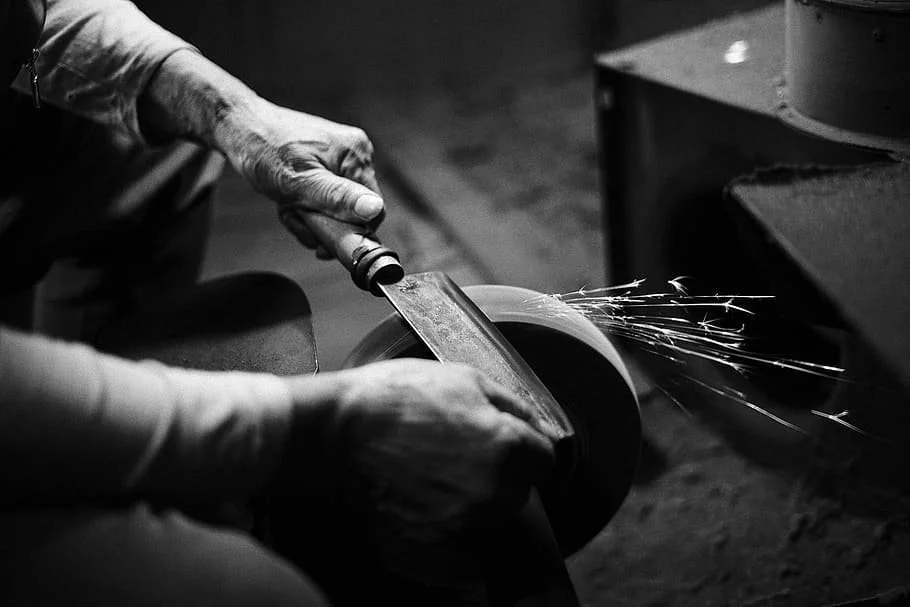
A blade sharpens against resistance, not in spite of it. A muscle grows under load just as the mind clarifies through the struggle to articulate something difficult.
Every domain that produces lasting things — science, art, business, writing — runs on the same principle.
The hard part isn't the obstacle. The hard part is the point.
It's the very mechanism by which something ordinary becomes precise, or beautiful, or true.
We have spent a considerable amount of energy in recent years trying to engineer friction out of our lives and workflows, and we have not stopped to ask what we might be engineering out along with it.
I wonder about this.
***
The surface problem with AI-generated writing is that it's generic, occasionally wrong, and instantly recognizable as nobody's voice.
The more interesting problem is what happens to the person using it.
Outsourcing your ideation — gradually, then habitually — dulls your taste, your intuition, your capacity for the unexpected.
It turns you into what researchers call a stochastic parrot: endlessly fluent, producing the most probable output, incapable of the deviation that makes anything worth keeping.
Good writing creates good thinking. Not the other way around.
This is what gets consistently backwards in the current conversation: the assumption that thinking happens first and writing merely records it. But anyone who has sat down alone with a blank page and something genuinely difficult to say knows the opposite is true. You don't know what you think until you've fought to say it.
The thinking happens in the friction.
***
So what do we do with the tools we have?
I don't think the answer is refusal. I'm not writing this on a yellow legal pad. (I considered it. I did not do it.)
But there is a difference between reaching for assistance and outsourcing the friction that makes you better. There is a difference between using a tool and letting it use you. There is a difference between staying sharp and, without noticing, becoming dull.
Precision and beauty come from the same place: the struggle to make something worthy of the effort.