Today, I want to tell you a brief story about a hotel.
This small hot spring hotel is called Hoshi Ryokan. It's buried deep in the mountains of Japan. From the outside, there is nothing particularly remarkable about it. It has about a hundred rooms and costs roughly two hundred dollars a night for a suite.
But this ryokan holds a very special distinction: it was founded in the year 718 AD.
To put that in perspective, Hoshi Ryokan opened its doors a thousand years before the Declaration of Independence was signed. And it was founded two hundred years before the Kingdom of England was established in the year 927 AD.
Perhaps even more remarkable is that this business is still operated by the same family, now in the forty-seventh generation of continuous ownership.
It is, definitively, the oldest independent family-run business on Earth.
To say that this is a resilient business would be the understatement of a century — or, more accurately, a millennium. The business has survived countless economic cycles, regime changes, succession battles, natural disasters, and, more recently, a few snarky Yelp reviews.
And yet, it's still here.
Over its lifespan, the business has hosted all manners of guests, from Japan's royal family, shogun dictators, imperial emperors, samurai warriors, spiritual leaders, and, more recently, a decidedly less remarkable visitor — me.
This year, it celebrated its 1,308th birthday.
***
All of that preamble to ask a very simple question: how is this possible? What could possibly explain this incredible outlier of endurance? Of family succession? Is it luck? Is it randomness? Is it a specific, secret formula of long-term success?
That's what I'll be exploring today.
Now, I'll admit: I can't possibly explain the precise, singular reason this particular business in this particular region of Japan has survived for so long.
Like all things in life, the deeper you go, the more complicated it gets. It’s messy.
But I do have a theory.
And that theory boils down to a very simple word: stewardship.
Stewardship, as I might define it, is a philosophy of care. It removes the ego from every aspect of life with a total focus on simply serving those around us.
Stewardship, I'd argue, is the most important concept in business that rarely gets the examination it deserves.
And I think it’s very much part of the reason why this company in particular has survived for so long.
So let me first tell you the founding story.
***
It begins in 718 AD, when a Buddhist monk named Taicho Daishi was traveling through the mountains of what is now Komatsu, Japan, and came upon a hot spring deep in the hills. The water was warm, and the legend, as has been told across generations, is that this particular spring had magical healing powers.
Now — unlike a gold prospector of the 1800s, or maybe a real estate speculator of today, Taicho did not claim the spring for himself. He did not seek to commercialize it or extract profits from his discovery.
Instead, his first action was something different altogether: he gave it away.
In the months that followed his discovery of the spring, Taicho Daishi adopted a young man to help build a small inn around the flowing water.
The only thing he asked for in return was a promise: that this young man would protect the spring for all future generations. That he would preserve it for weary and sick travelers looking to be healed.
He gave the young man a name: Zengoro Hoshi.
Every steward since the first Zengoro Hoshi — all forty-seven of them, across thirteen centuries — has lived with a very simple belief: their business exists to help people in need of healing.
It is their family’s duty — indeed, a moral ambition — to cultivate and maintain the eternal health of the business. This takes patience, restraint, and an utmost respect for the quality of the experience for the guests themselves.
***
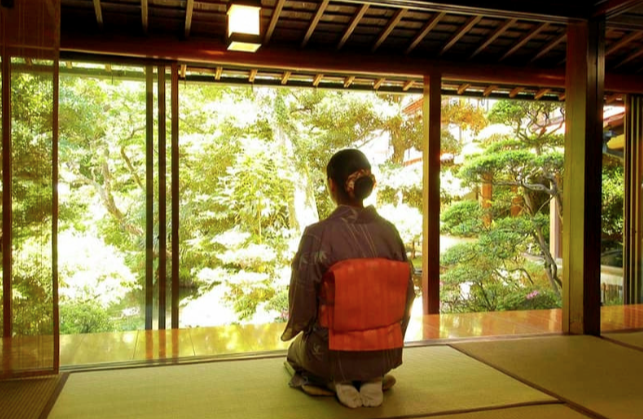
Last July, I took a three-hour train ride from Kyoto to the hotel.
I entered through large oak doors, slipped off my shoes, and was handed a wooden key to my room. The hotel today is a sprawling structure of corridors that center around a mossy Japanese garden that has been cultivated for centuries.
I got myself settled, and soon sat down with the forty-seventh-generation steward — the first woman to lead the business in over 1,300 years. Though her given name is Hisae Hoshi, when she took over the business, she adopted the formal family name, Zengoro Hoshi.
Zengoro explained that the inn has a longstanding saying: it welcomes "monks to emperors" — meaning from the poorest to the richest. It's an open-door philosophy that has been passed down for generations and still guides how they think about hospitality.
To her, the inn exists to serve everyone, not to maximize her shareholder value, or to optimize for the highest-paying customer.
She told me many stories about the traditions her family has kept. One of them stood out to me.
She told me how every morning for over 50 years, her father would put on a pair of white gloves, walk to a gong in the garden, and ring it.
Guests who heard the gong would come and sit with him, and he would talk about the inn, about his family, their families, about nature, and about what it means to endure for so long.
He liked to say, “we learn from water. Water adapts and finds a way.”
Like any business owner, she also talked about the struggles.
And in many ways, Hoshi Ryokan is facing a pretty gnarly drawdown.
Some investors in this room, myself included, have gone through rough periods. But if you're ever feeling bad about a three-year stretch of underperformance, consider that Hoshi Ryokan is currently experiencing something like a thirty-year downturn.
As she explained it, her father made the mistake of taking on too much debt in the 1990s and over-expanded the hotel. Essentially, he levered up at a pretty bad time.
Today, there are entire wings of the hotel that are dormant because they can no longer maintain them with integrity. So they've downsized.
Perhaps even more devastating was that Zengoro’s brother — the designated heir of Hoshi Ryokan — died unexpectedly several years back.
In fact, towards the end of our conversation, she admitted to me that she never planned to run the place. Frankly, she didn't want to.
But she understood what the business had represented for over a thousand years: a place to take care of people. She respected the ambition of her parents and her ancestors to create a special place that treated customers well — customers who returned season after season.
So when her father came to her and said, "It has to be you" — she said yes.
She understood, implicitly, this idea of stewardship.
***
Later in the day, we took a walk together through the property. I found it funny — she kept pointing out little flaws here and there to her staff. She'd find a piece of paint missing on a wall and summon a handyman. Or she'd point to some towels and ask the manager to re-fold them.
I realized she had a very specific idea of quality for the customer. She was obsessed with getting all the little details right.
Many times throughout our interview, which was conducted through a translator, I would ask her questions about her ownership of the hotel.
But her response was that she didn't even consider herself an owner, even though she technically owned the business.
Instead, she considered herself a caretaker: a person whose job it was to ensure the business survives for the next generation.
In many ways, she saw herself like a gardener — someone whose role was to simply cultivate the property, over time, through good seasons and bad.
***
Which leads to a hypothetical question for us in this room.
What if, instead of calling ourselves CEOs or chief investment officers or owners or Vice Presidents or Research Analysts, we simply called ourselves caretakers of the businesses we steward?
How would our actions change if we embodied this philosophy?
What deferred maintenance would we stop deferring?
What would it do to the quality of our work?
What investments would we make today knowing that we may never live to see the payoff?
It reminds me of the Greek proverb: "A society grows great when old men plant trees in whose shade they shall never sit."
When I asked Zengoro Hoshi what her goal was for the inn, her response had little to do with growth, scale, expansion, innovation, or anything else you might expect a typical owner to say.
Her response was simple: to hand the business to her nephew in better condition than she inherited it. That was it.
***
It reminded me of a phrase I had long forgotten — tikkun olam.
It is a Hebrew expression that translates, roughly, to "repair a broken world." The concept holds that the world, as it exists, is broken — and that the purpose of a human life, the actual point of being here, is to participate in its healing. Not to extract from it, or to accumulate, or even to compound. The purpose is to heal.
Tikkun olam is not about grand gestures. But it is an orientation. It is about whether you move through the world as someone who is taking, or as someone who is giving back.
It strikes me, thinking about this little old hotel, how similar their philosophy is to tikkun olam.
Remember, the monk who found that spring in 718 AD said, "Build something here so people can be healed." Of course, he did not know he was starting what would be a 1,300-year business.
***
Let me close with something a bit more personal.
I have two young girls at home, both under the age of five. Many of you have children as well. Maybe grandkids too.
When we talk about our kids, we don't talk about "building" them. We talk about nurturing them, about taking care of them, about giving them the resources and skills to survive so that, one day, they can live without us.
I think businesses are not that different. When you treat a business not as something to be "built" or "grown," but instead approach it with care, with duty, and with love — you create the conditions for something that can outlast you.
Since working on this book, many people have asked me: what's the secret to longevity?
The answer is that I'm still working on it. And I owe the book to my editor at Scribner in about four months.
But I will say that that is very much the wrong question to ask.
Longevity shouldn't be the end goal. Longevity is what happens when you stop thinking about longevity altogether — when you focus instead on the quality of what you're doing right now, for the people you serve, with everything you have.
Before I left the hotel, the forty-seventh generation told me that her father had a saying he repeated to her constantly: everything is temporary within your hands. You own nothing. You are simply passing it down.
That is stewardship. A daily act of selfless love.
So — find your hot spring. Find the thing you believe is worth passing on. Take care of it. And who knows — maybe one day, long after we are all gone, your business will celebrate its 1,308th birthday, too.
Thank you.